Facing death with bravery and grace
As a former palliative care nurse, Janet Willis was very familiar with the disease progression of Motor Neurone Disease and how people suffered at the end of life.
"We all said, as nurses, that's the disease we don't want to get,’’ Janet said.
Just months after she retired from her 50 year nursing career, at the end of 2024, she was having some choking episodes and difficulty swallowing. Her diagnosis of MND was confirmed in March, 2025.
Janet, from rural NSW, googled voluntary assisted dying (VAD) soon after her diagnosis and called the NSW VAD Care Navigator Service. She received her approval in May and planned to have VAD at a multipurpose health hub in the Glen Innes area. She was going to be the first person to use VAD at the hospice there.
However, despite her meticulous planning, Janet did not get her end-of-life choice.
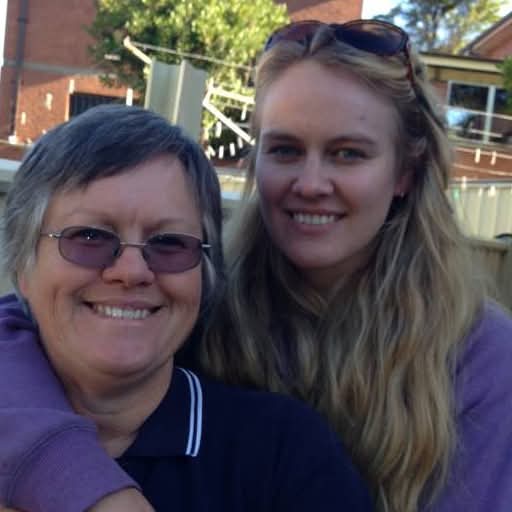 She was admitted to hospital in Newcastle with breathing difficulties and, upon her return, called the NSW VAD team and booked into the hospice. But the VAD team could not get a practitioner to administer the VAD substance until the following week.
It was too long to wait. Janet died under heavy sedation, her lungs filled with fluid, to the disappointment of her loved ones who knew that was not the ending she wanted.
Janet’s daughter, Lara, said: "We are disappointed mum did not get to activate her VAD plan as the VAD team could not mobilise quickly enough to help her when the time came. When Mum called them to say she was ready, the soonest they could get to her was the following week,’’ she said.
“Mum unfortunately had an MND death where she basically drowned as her lungs were full of mucus. The only blessing was she was on a syringe driver and knew nothing of it.”
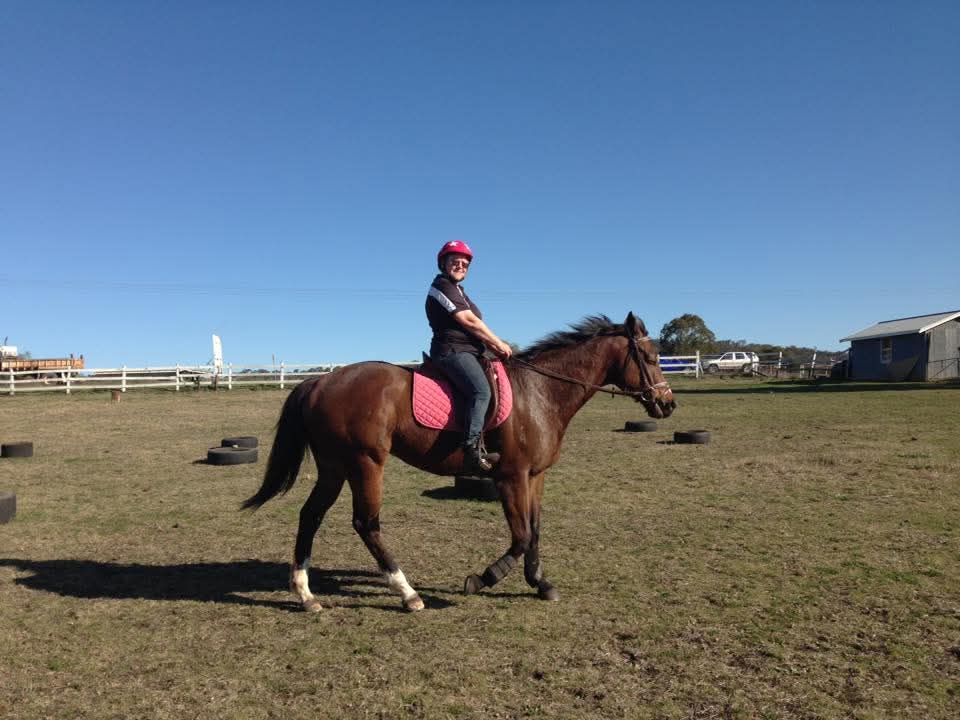
Janet had been a fierce advocate for VAD, not only for herself but for other Australians.
She spoke to Go Gentle some months before her death, about her decision to use VAD, and how her attitudes had changed since her diagnosis with MND.
“When I was a palliative care nurse, I felt there was no real need for VAD. But that was a very selfish attitude. Now my whole mindset has changed with this diagnosis,’’ she said.
“I feel very relieved to have that option and I know I’m going to have a peaceful death. It won’t be an MND death. It will be like going to sleep under deep anaesthesia."
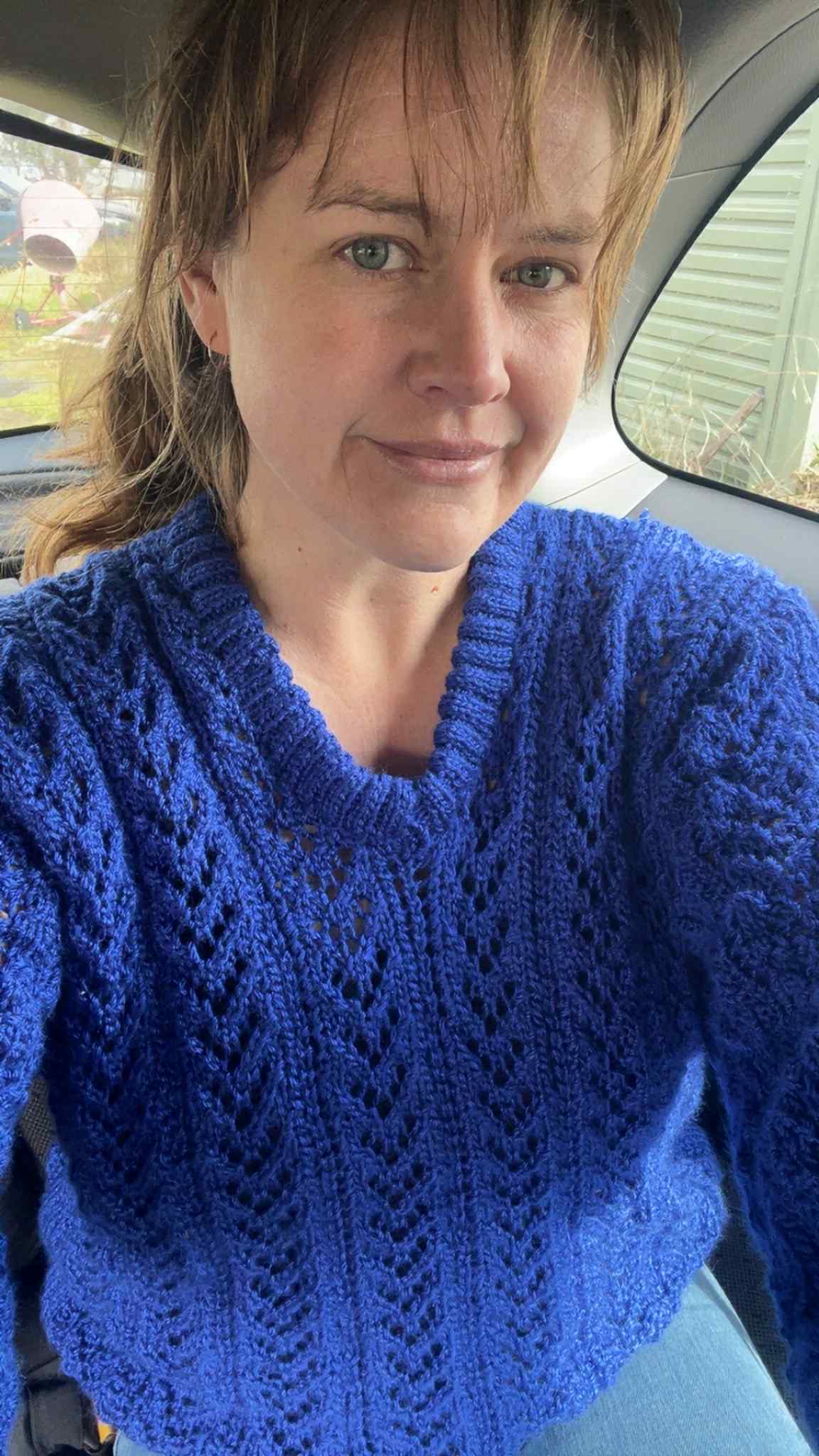
Despite difficulties with speech and swallowing and deteriorating mobility, Janet was determined to make the most out of her remaining time. Her priority was quality time with loved ones.
“I’m spending time with my family. I've knitted a jumper for my daughter; I’m sorting out paperwork and filing things. I’ve got so many friends and family calling me to say their goodbyes,” she said.
She used her voice to advocate for VAD in the Northern Territory, speaking on ABC Radio Darwin.
“People in the Territory are Australian, they should have the same rights as elsewhere. I would like everyone to have that option, and be able to choose…whether they want it, whether they don’t want it. It should be a basic human right,” she said.
She was also a guest on Suzanne James’ Nightshift podcast, where she praised the NSW VAD team for their care and sensitivity during the assessment process. “I couldn’t have asked for more,” she told the podcast.
The media interviews opened opportunities for frank conversations about death and dying with her loved ones.
“It’s given me a platform to speak to my friends and family and they know I’m not frightened of dying - so it has alleviated their distress. They are very supportive. We crack jokes. It’s not a taboo subject.”
She added: “People say I’m brave but I’m not brave. VAD has given me a peaceful way out.”
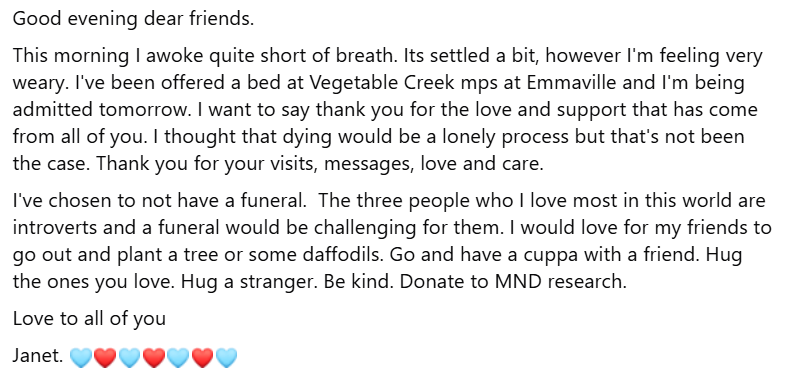
In her last Facebook post, Janet said she was having trouble breathing and that she was being admitted to the hospice where she had planned to have VAD.
With characteristic generosity and humility, she thanked her friends for their love and support. In lieu of a memorial service, she encouraged them to “plant a tree or some daffodils. Go and have a cuppa with a friend. Hug the ones you love. Hug a stranger. Be kind. Donate to MND research.”
She also said: “I thought that dying would be a lonely process but that’s not been the case.”
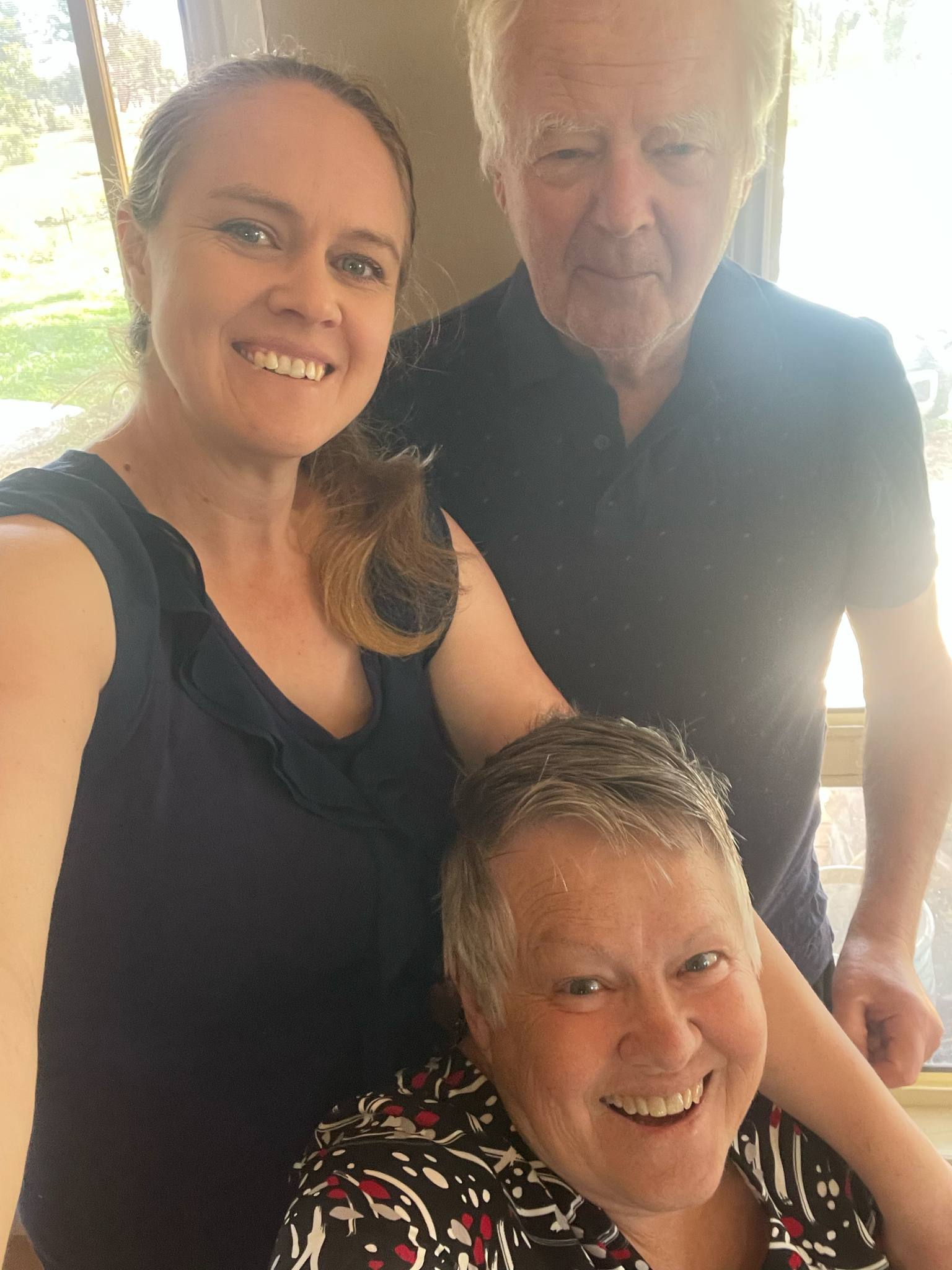
Lara Willis said she hoped that her mother’s case could be examined as part of the upcoming NSW review of the operation and effectiveness of the VAD legislation.
“I feel that VAD access in rural and regional areas could be improved and needs to be looked at,’’ she said.
One of the two key principles of the review, which comes two years after the NSW law commences, is equal access to VAD for regional residents.
The latest NSW VAD annual report shows strong demand for VAD outside of major cities, with 41.5% of NSW patients who had a first assessment being resident in regional and remote areas.
Read more about the latest NSW VAD annual report.